 Accessibility Sentinel
An R&D lab for digital accessibility. Your site could be audited for free.
Accessibility Sentinel builds automated detection methods for WCAG and RGAA compliance — automated scanners, real evidence (screen reader, session timeout, vision triage), independent evaluation of 162 criteria. To refine these methods on real cases, we're opening a limited number of complete, free audits: 100% of the features, in exchange for an anonymized case study and feedback.
Your site is the fuel for our lab
A research lab needs real cases to validate its methods — not mockups. Rather than billing for our first audits, we give them away in full, in exchange for use as a case study and honest feedback.
100% of the features
The same audit we'd otherwise charge for — no watered-down version: automated scanning, real evidence, 162 WCAG + RGAA criteria, full deliverables.
Two simple commitments
Authorize an anonymized case study and give us feedback — no payment requested.
A limited number of spots
Every application is reviewed; we favor real sites and a diversity of sectors and tech stacks.
On our reference project
An independent audit of a high-traffic transactional website — the figures below come from that real project, detailed in our case study.
What sets us apart from standard scanners
Accessibility Sentinel grew out of an R&D lab building automated detection methods for digital compliance — we're not a certification body, we surface concrete evidence and testable protocols your team can act on. Most audit tools stop where automation stops: they cover a fraction of WCAG/RGAA criteria, and the rest gets tagged "manual check required" and left there. We start from the opposite premise.
Real evidence instead of assumption
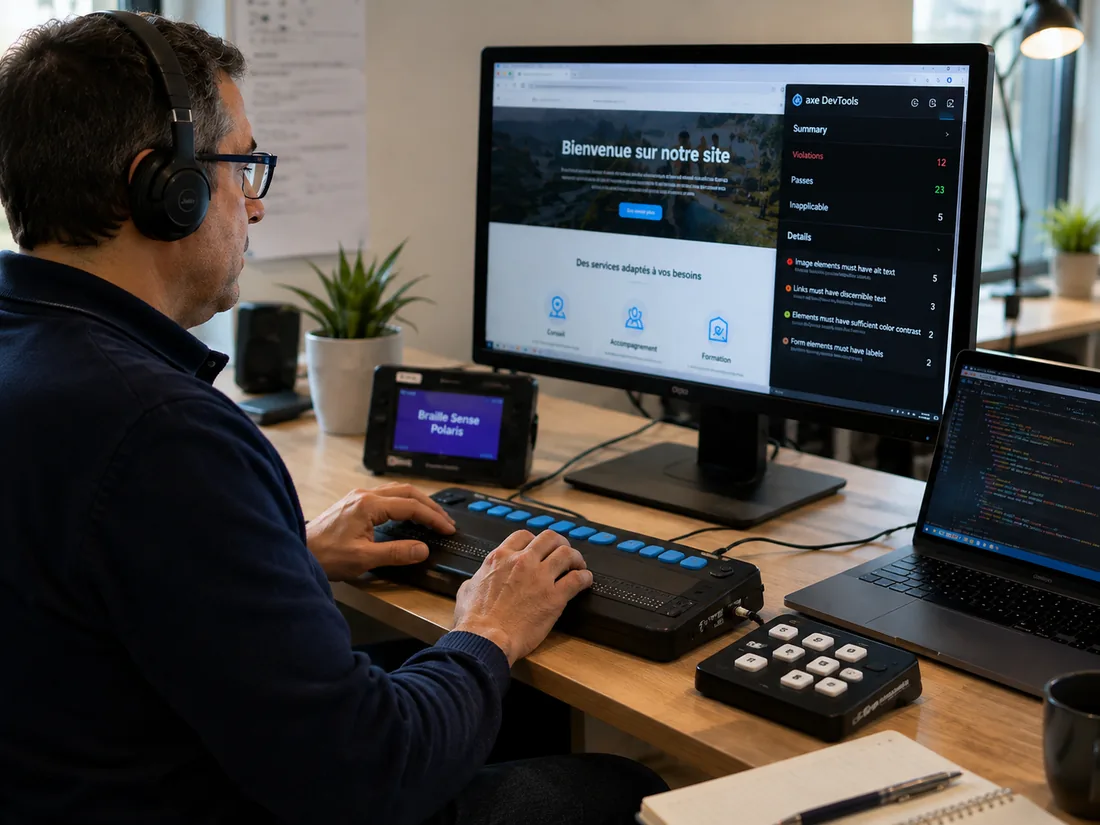
The speech a real screen reader (NVDA) actually says, an actual 30-minute wait to test a session timeout, a real simulated touch gesture — not heuristics approximating user behavior.
Every "manual" criterion stays actionable
For every criterion that can't be automated, a precise test protocol (tool, actions, pass/fail criterion) instead of a plain tag — a human auditor can pick up the work without starting from scratch.
WCAG and RGAA, two standalone frameworks
56 WCAG 2.1/2.2 A/AA criteria and 106 RGAA 4.1.2 criteria tested each on its own terms — a simple mapping table produces both false positives and false negatives. The RGAA is due to evolve into a version 5, currently being drafted.
Honest about the limits
Screen-reader parity, a payment step never gone through, alternate-version fidelity: we document what remains fundamentally manual instead of hiding it.
Every verdict carries its evidence AND its method's limit
Our multimodal vision/language model's judgments are counted separately (dual rate displayed: official vs. mechanically proven) and verifiable by sampling, rather than diluted into a single score.
Capability catalog
Large-scale automated detection, real evidence, scaling to a whole site, and deliverables ready for your teams.
Automated detection
axe-core 4.9.1 scanning in a real browser, DOM inspection (accessible names, heading structure, ARIA roles), automated keyboard navigation, contrast, 200% zoom, text spacing, office documents.
Real evidence
A bridge to NVDA with exact quotes of the speech heard, a real session-timeout test, vision-model-assisted triage for unlabeled icons, touch-gesture simulation.
Scaling to a whole site
Parallel automated crawl to audit hundreds of pages in cascade, aggregating systemic defects (shared component rather than isolated symptom), explicit scoping.
Deliverables ready to use, in French and English
Structured CSV & Excel workbook
One finding per row, normalized columns (severity, WCAG criterion, RGAA criterion, detection method). Multi-tab workbook with native formulas, not hardcoded values.
Word report & interactive chat
Executive summary, detailed findings, annotated screenshots at exact DOM coordinates. Chat interface to query results in natural language, citing finding IDs.
Every deliverable ships as two separate files — French and English — not a single mixed-language document.
Ready to know where your site stands?
Tell us about your site and any regulatory deadlines (EAA, RGAA...) — we'll come back with a clear scope.